

Guidance for non-profit organisations and charities in Jersey
What is the difference between an NPO and a charity?
In Jersey, a non-profit organisation (NPO) and a charity are not the same in law, although the terms can overlap. All Charities are registered as NPOs, but not all NPOs are charities. The main differences are in their purpose, legal status, and how they are overseen.
Follow the steps below to determine:
- if your organisation is an NPO
- if your NPO is classed as a Prescribed NPO
- if you can register separately as a charity
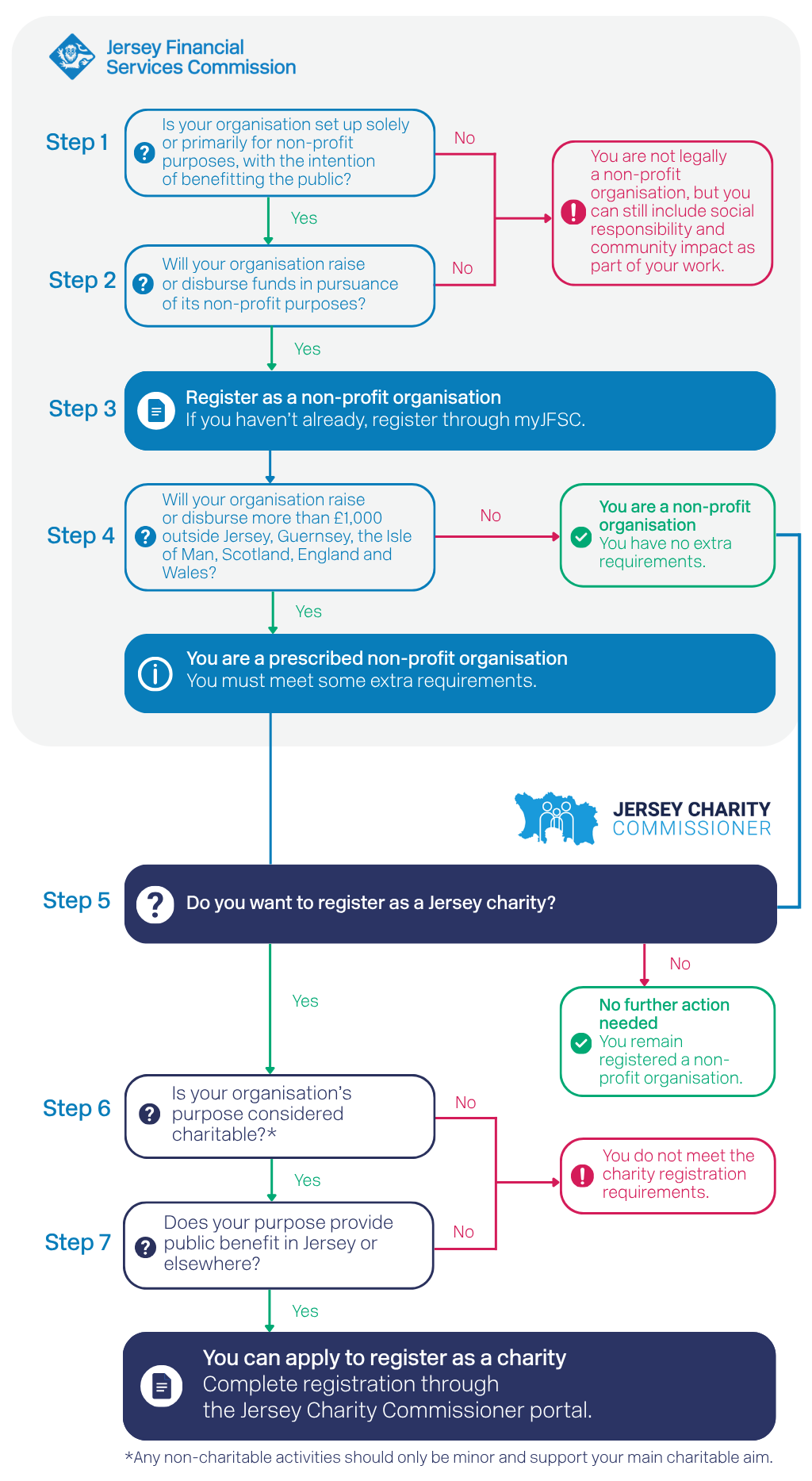
Key differences
| NPO | Charity | |
| Legal status | Classed as ‘Registered NPO’ or ‘Prescribed NPO' | Classed as a ‘Registered Charity’ |
|---|---|---|
| Registration | Mandatory (definition set out in the NPO law) | Voluntary. The test set out in the Charities Law. |
| Governing law | The NPO Law for NPOs, and the Prescribed Order for Prescribed NPOs only | The Charities Law |
| Governing body | The JFSC oversee and monitor the risk of NPOs being misused and abused for terrorist financing | The JCC works to protect public trust and confidence |
| Does the organisation have to provide public benefit? | Yes, must raise and disburse funds for its not-for-profit purposes | Yes, must be exclusively charitable |
| Can I fundraise? | Yes | Yes |
| Do I have tax relief? | No automatic relief | Yes |
| Am I on the public register? | No | Yes |
| Am I a charity? | Not automatically. You must also meet the charities test | Yes, and an NPO |
My organisation meets the definition of an NPO. What does this mean in practice?
You will need to register with us. Registration can be completed through myJFSC.
You will need to keep a financial record, provide certain information on request and notify us of any material changes to your NPO since registration.
Please then review step 4 of the flowchart to see if your NPO is also classed as a Prescribed NPO. If so, there are a small number of additional obligations to be aware of, which are outlined in the next section.
My organisation is classed as a Prescribed NPO. What does this mean in practice?
If your NPO is classed as a Prescribed NPO, you have some extra obligations set out in the Prescribed Order. These requirements are designed to formalise good governance practices that your organisation may already follow.
Here is a summary of the additional obligations:
- Article 2: prepare an annual financial statement. You do not need to send us a copy unless we ask. The level of detail should match the size and complexity of your NPO. For example, a large NPO may have a full audited statement, while a small NPO may only keep a list of income and spending.
- Article 3: have suitable accounting systems and controls. The level of controls should match the size and complexity of your NPO. For example, a large NPO may use accounting software, while a small NPO may use a spreadsheet, or written records.
- Article 4: keep a record of owners and controllers so that you can identify and contact them (such as full name and address). You do not need to collect “due diligence” such as passports etc.
- Article 5: keep a record of significant donors. This means anyone who has given £10,000 or more, or over 50% of your total donations in the last 12 months. Again, just keep enough details to identify and contact them.
- Article 6: take reasonable steps to identify other NPOs and beneficiaries that you are working with and understand the nature of the relationship and any activities that they are carrying out on your behalf. This is about taking reasonable steps to be sure of their identity and that your funds are being used as intended.
The only additional requirement is outlined in our NPO Handbook, which says that your NPO must also have a risk appetite statement (RAS).
A RAS is a short document that explains the level and types of risks your NPO is willing to accept. You can find more details in Paragraph 26 of our NPO Handbook.
Prescribed NPOs are supervised by the JFSC on a risk-based approach, with more focus on those that may be at higher risk of being abused or misused for terrorist financing.
If you have any concerns about the above obligations, please contact the NPO team at npoenquiries@jerseyfsc.org. We want to support your good work and are happy to discuss any questions that you may have.
My NPO would like to register as a charity. What should I consider?
If your NPO wants to register as a charity and meets the test under the Charities Law, it will obtain charitable status.
As a Jersey Charity, you will need to:
- have a written constitution
- submit an annual return, including providing copies of your financial statements
- follow the governance duties for charity governors
- meet the transparency and safeguarding requirements
Jersey charities are overseen by the Jersey Charities Commissioner (JCC), and details of all charities are added to the public register which you can find on the JCC's website.
Key considerations
The JFSC and JCC do not set rules about which legal form an NPO or Charity should take, but you may want to get legal advice before changing or setting up a new structure.
The NPO and charity registration processes are separate. Being an NPO does not mean your organisation can automatically register as a charity.
Registering as a charity is voluntary. However, you must register if you want to call your organisation a charity. It is an offence for a Jersey organisation to describe itself as a charity if it is not registered.
If your organisation does not meet the definition of an NPO or a charity, you can still include a non-profit or social enterprise element in your work.
Some examples of organisations that are not an NPO or a charity include:
- commercial businesses
- political parties
- closed membership groups, such as trade unions, parent-teacher groups, or professional associations
- culture groups, such as book clubs
- neighbourhood groups
- thrift clubs that are only for saving or have a gambling element
Definitions
Raising funds: means funds given to the NPO, but does not include:
- income earned on the funds of the NPO
- amounts paid to the NPO by persons to become or remain members of the NPO
Disbursing funds: means a transfer of money to a beneficiary to fulfil the objects of the organisation. This does not include:
- funds paid by people to join or remain members of the NPO if those funds are used only for the benefit of members
- payments made for goods or services at an agreed price